Friday, May 2, 2014

Chicago's Ban on Plastic Bags Doesn't Ban Plastic Bags

The headlines scream "Chicago Bans Plastic Bags", but is that really the whole story?


Probably the simplest way to understand Chicago's new, and potentially ineffective, ban on plastic bags is the way young "Activist Abby" [Abby Goldberg of Grayslake, IL] explained the effect of the aldermen's decision on her Facebook Page. [See below]


Abby was only twelve when her petition to Governor Quinn [with tens of thousands of signatures], got him to veto a bill endorsed by plastic bag manufacturers. This bill would have prevented local governments from passing ordinances to ban plastic bags in their towns. 


Here's what Abby posted about Chicago's recent ban on plastic bags, which, for some reason, will still allow "compostable" plastic bags: 


Green Plastic Bags = Biobags or compostable bags. Are they really green?

1] These bags do not degrade on the side of the road, in our waterways, or in your backyard compost pile. Our neighborhood farm [Abby's] that collects our compost refuses these bags because their compost pile does not get hot enough to degrade them. 

2] They do not degrade enough in a capped landfill.

3] The "green plastic" cannot be recycled! Sometimes people mistakenly put them in the recycling bin used to collect ordinary plastic bags and this contaminates the whole bunch. BLOG EDITOR'S NOTE: Some towns have ordinances that require ordinary plastic bags to be picked up by companies and returned to the few plastic bag manufacturers who are willing to chop them up and combine them with new plastic to make. . .wait for it. . .more plastic bags. And they call this recycling. 

4] They [the "green" bags] are still an eyesore as litter, a danger to animals, get caught in sewer grates, and act exactly like ordinary plastic bags. 

5] The term "Biobags" and "Compostable bags" is confusing to everyone. Most often biobags still have chemicals and plastic in them. EDITOR'S NOTE: Abby calls this "Green Washing" which Wikipedia describes as a "form of spin in which green PR or green marketing is used deceptively to promote the perception that an organization's products, aims or policies are environmentally friendly."

6] We use crops [corn usually] to make these bags, which require water, fertilizer, pesticides, and lots of energy for their growth. 

7] Green plastic bags are still something we use once and throw away!

Jordan Parker, Chicago's main proponent for really and truly banning the use of all plastic bags in favor of REUSABLES, wrote an excellent opinion in the Chicago Tribune that explains further what's wrong with Chicago's ordinance. [Her byline for the piece uses a different name].


She and Abby both agree, Chicago missed a huge opportunity because REUSABLE is the way to go. 

Wednesday, April 23, 2014

Busy Weekend! • Friday Movie • Saturday Go Green Northbrook Joins 50 Exhibitors Promoting Earth-Friendly Ideas!

FREE
•FRIDAY NIGHT• 
Go Green Northbrook presents
"QUEEN OF THE SUN"
Everyone is Welcome • Discussion Afterward   
• SATURDAY •
Earth & Arbor Day Celebration
Go Green Northbrook
Joins 50 Other Exhibitors
On the Village Green
9:30 AM to 1:00 PM
[Come at 8:30 AM to help with village clean up]


Saturday, April 19, 2014

Have You Thought About Raising Bees?


Bees are dying all over the word. Mites, viruses, parasites, bad weather, pesticides, lack of forage, and who knows what else, are conspiring to decimate the bee population. With bees in mind, maybe this is the year to learn more about organic lawn maintenance and skip the chemical sprays. 
          Meanwhile, interest in beekeeping is growing among green gardeners living in North Shore communities. On tax day, April 15th, some members of Go Green Northbrook went on a field trip to Highland Park's Heller Nature Center.  We joined several other folks from the northern suburbs who wanted to watch and learn about bees from naturalist, Leah Holloway, Heller's Head Beekeeper. Among Leah's many responsibilities, she is in charge of maintaining all the hives. 
          After a long, difficult winter, hives can die from the cold or run out of their supply of honey and starve. So even though it was chilly, the day was planned around preparing a batch of sugar water to feed the bees. The sugar water helps build up the bees' strength -- and provides a bridge between the end of winter and the blooming of flowers. This year it seems like winter won't end. And the flowers are taking forever to come up. 
          The sugar syrup recipe is fortified with lemongrass and other herbs to strengthen the bees' immune systems. A small amount of lemon juice per pound of sugar is added to help breakdown the sugar molecules to make it more like nectar, which is easier for bees to digest and put to use in the hive. Here are some links so you can learn more about feeding bees: Bee Hive Journal and The Bee Works.

Leah Holloway's friendly face greets the volunteers as they arrive at the Heller Nature Center. If you want to become a volunteer, call Heller @847-433-6901 to sign up. Before you volunteer, read some interesting FACTS about honey bees. Here's a TED talk about bees that discusses the slow, but relentless demise of bees over the last fifty years -- HERE

To start working around the bee hives, the volunteers have to climb into their bee suits. So we follow Leah outdoors to the new, critter-proof metallic container, where the bee supplies are kept.

          The Heller bees are very generous with their payback to the beekeepers. Every summer, honey from the hives is bottled and sold to the public. Proceeds from the sale of honey help support Heller's beekeeping and education programs.
                                                                    

It's been a long winter. There are just a few honey sticks left for sale. 
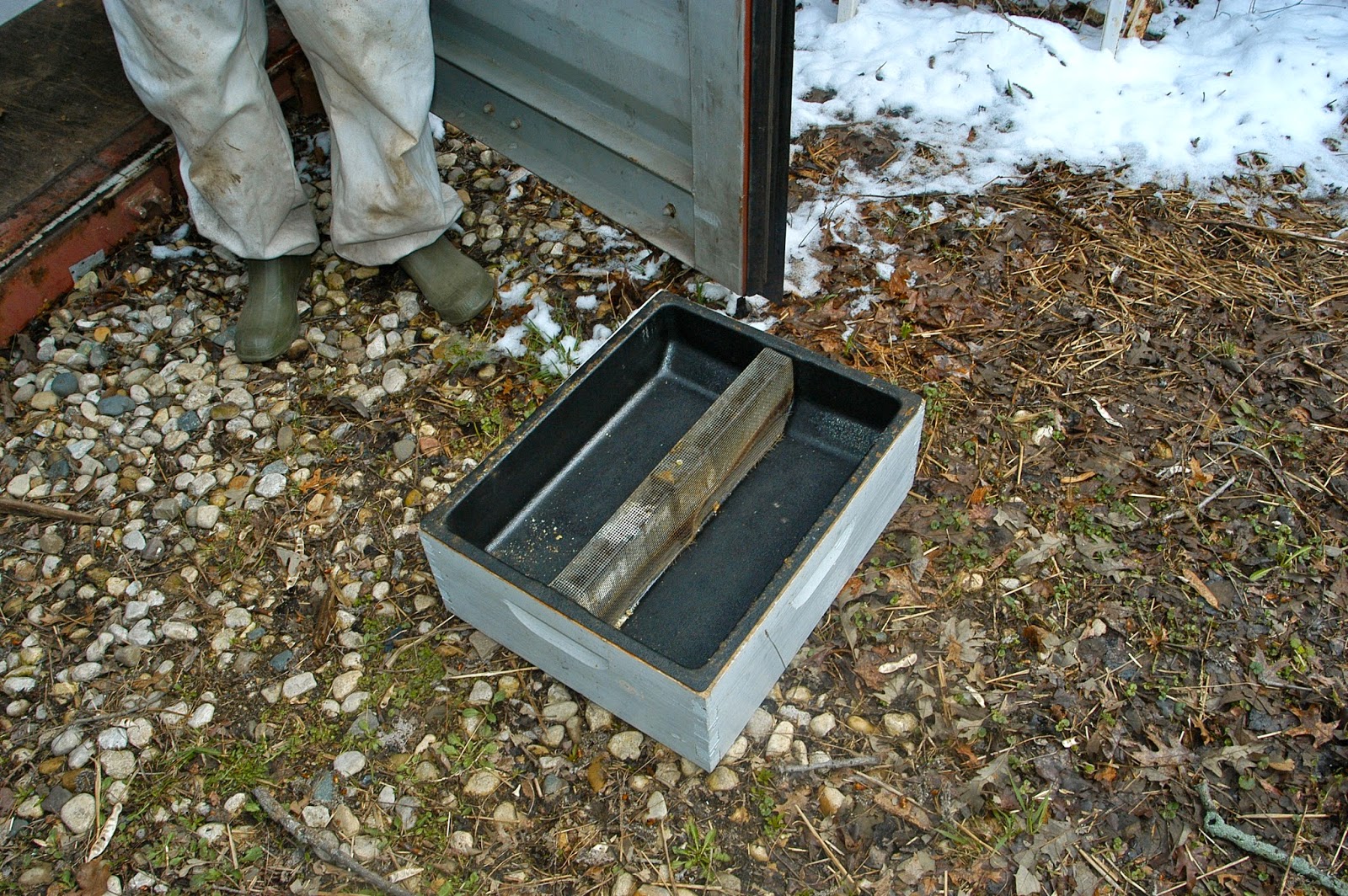
The feeder boxes stored on the left will hold the sugar syrup, which the bees access from inside the hive, through the bottom center of the feeder box. Opening the hive to put the feeder box in place takes effort with a pry tool, because the bees seal up any spaces with propolis or Bee Glue -- a resinous mixture the bees make from sap and other botanical sources. It's a natural disinfectant and antibiotic. According to Leah, Bee Glue works better than some commercial products.


      Volunteers eagerly start climbing into the bee suits. Not because they're flattering. As you might expect, anyone working around the hives is required to wear protective covering. Bees don't take kindly to human disturbances, no matter how well intended. Here's a LINK to an online store that prides itself on cheap bee suits, in case you want to get your own. Or need a good costume for Halloween.

Below is a view of the inside of a feeder box. There are many kinds of feeder boxes. With just as many opinions about which ones are best. Here's a LINK to give you an idea. At Heller, the center of the box is screened to separate the bees from the sugar syrup -- to help protect them from falling into the liquid on either side and drowning. Unfortunately, this still happens from time to time.


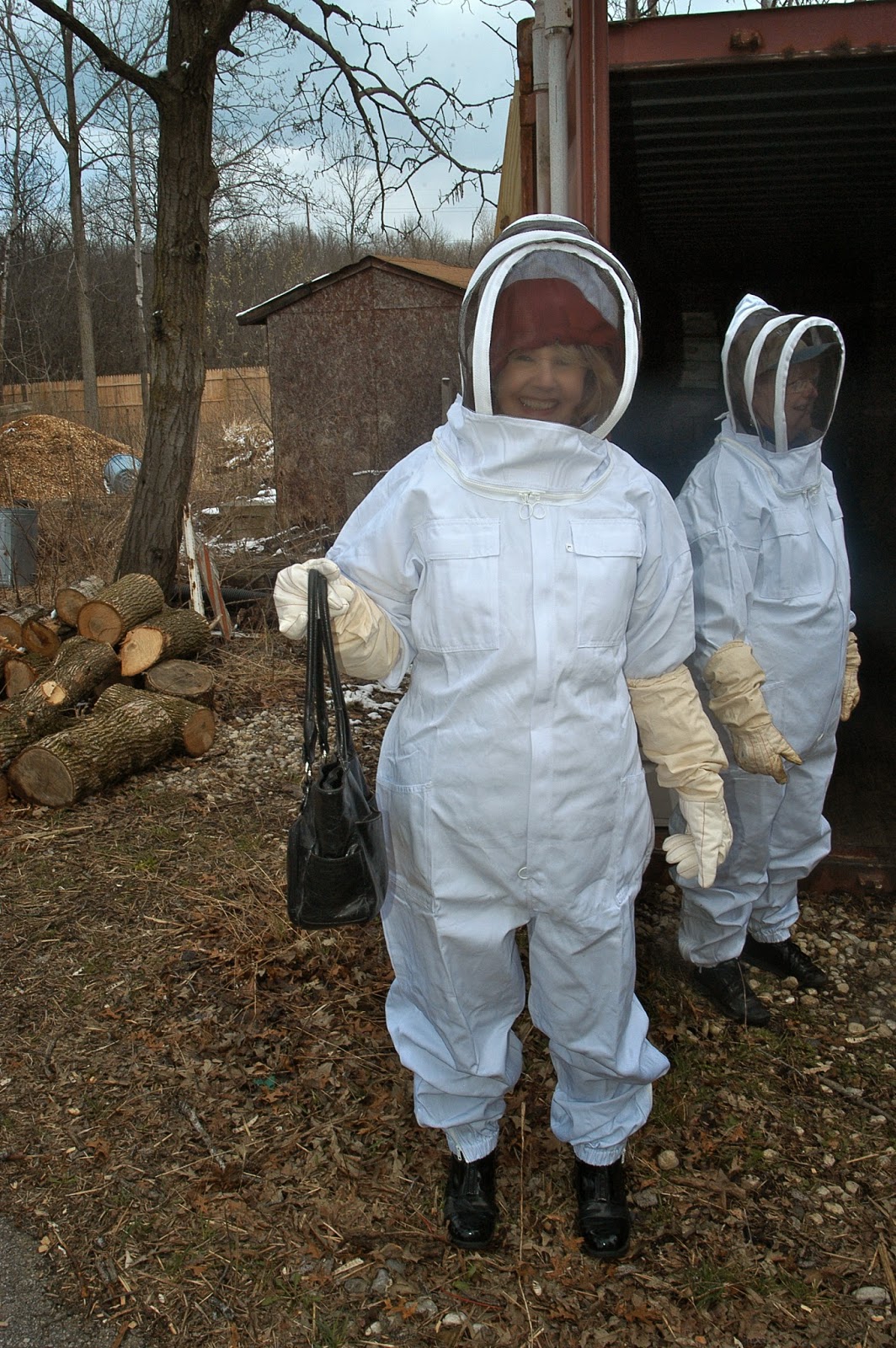
After the bee suits come the gloves. The protective gloves fit high up on the arms, over the elbows. There are elastic bands on the bee suit sleeves that stretch over your thumbs to keep the sleeves from riding up when the gloves go on. Here's another LINK to an online store that carries a range of equipment and supplies you'll need. Just remember, no matter how much equipment you wear, you'll probably get stung anyway. It goes with the territory.


GGN's Barbara Gerleman models the latest in leather accessories for the fashionable beekeeper. We finally found a place to stash her handbag, so she wouldn't have any stray bees flying out of her purse on the way home. Next time she'll probably keep it in the trunk.

GGN's Merilee Novinson is sealed up nicely inside her bee suit. No tiny openings where a bee could crawl in. We noticed that the additional warm clothing needed on the cool, damp, spring day made the fit of everybody's bee suit kind of snug.

Time to carry the feeder boxes out to the hives. If you're curious about what's happening to kill off the bee colonies, here's another LINK that talks about the problem.

On the walk to the bee hives, we pass a cabin designed by famous landscape architect, Jens Jensen, originally used as a children's playhouse. It was donated to the Heller Nature Center by a local resident. 
      The feeder boxes will be placed at the top of the hive, underneath the cover. Here's a link for beginners that shows the parts of a beehive. Here are two descriptions about what bees go through to survive the winter 1) how the bees keep warm in the winter and 1) what is a winter cluster? 

As part of Heller Nature Center's mission to educate, Leah begins to prepare their traveling bee exhibit for display. It is built to allow a good view into the workings of a hive.

She will fill the yellow container with sugar syrup once the syrup has been made. Next, she'll move one of the surviving colonies into the traveling exhibit. Of the eighteen hives they had last year, three survived the winter, which is not bad, given the stress bees are under and the harshness of the past winter.


Leah takes apart the exhibit hive in preparation for all the bees that will follow their queen, who will be moved to her new home, once the sugar syrup has been added.

She slides clear panels into place so anyone who views the traveling hive can easily see what the bees are doing inside the hive.

After setting up the first hive, it's time to make the syrup. Water straight from the hot water heater is added to sugar, followed by the special mixture of herbals essences [Pro Health] and lemon juice. The beekeepers at Heller used to make everything from scratch. but the cost became prohibitive, so they switched to ready made products.

Leah holds the lemon juice which makes the sugar more digestible for bees. The sugar should only be white sugar. No brown sugar or molasses. In the recipes we read, we noticed there are different ratios of sugar to water, depending on whether the syrup is used in the fall or spring or to stimulate brood rearing.
          The water should be close to boiling temperature to dissolve the sugar. Some recipes suggest bringing the water to a boil, turning off the heat, then adding the sugar. After combining all the ingredients, it's time to stir and stir and stir.                         

Lemongrass oil, spearmint oil, and lecithin are just a few of the ingredients in the Pro Health supplement added to the sugar syrup. There's also a mild laxative. During the winter the bees will leave the hive to evacuate their digestive systems, if it gets warm enough. However, following our recent cold winter, they may not have been able to leave very often, if at all. Enough said.  

The sugar syrup is poured into the container in the exhibit hive before the queen bee is moved into it.


The top of the hive is removed and the search for the queen begins. Once she has been found and moved to the exhibit hive, the rest of the colony will follow her distinctive pheromone. You may be able to see the bees piled in their winter cluster, bunched together for warmth inside the hive. After using a bee tool to open up the hive, Leah and the volunteers start moving the honeycombs and other infrastructure.


Needless to say, stirring up the hive with the bee tool is a process that annoys the heck out of the bees. But that's what the bee suits are for. If you're interested in trying your hand at beekeeping, we recommend signing up to be a volunteer at Heller Nature Center. You can also find starter kits HERE. And get your very own copy of Beekeeping for Dummies HERE.


You'll probably also want some remedies for bee stings, so here's a link from WEBmd.  If, instead of beekeeping, you want to plant flowers that attract bees, check them out HERE. Finally, you could start a Go Green Northbrook Beekeeper Team. And raise bees with other Northbrook residents. Just a thought. 

          We'll leave you with some pictures of flowers now blooming in Merilee Novinson's legendary yard. And a gentle reminder to plant some flowers that attract bees, plus a request to stop using pesticides and herbicides. 


Monday, March 31, 2014

Mosaiculture Exhibition Presentation • April 1 • Chicago Botanic Garden • 7:30 PM


Gardeners of the North Shore Program 
•Chicago Botanic Garden•
Tuesday, April 1 • 7:30 PM • Fairchild Room
••••  
GGN Member, Merilee Novinson, Presents a Slide Show Featuring the Amazing Topiaries of the Mosaiculture Exhibition in Montreal • Public is Welcome 

Monday, March 10, 2014

LET'S TALK TRASH!! Advanced Disposal Talks to Go Green Northbrook's Team RUBI


 Left to right: Lew Cohen, Captain of Team RUBI [Reusable Bag Initiative], Ben Dykstra, Area Manager, Advanced Disposal, and Doug Gerleman, Founder and Facilitator of Go Green Northbrook. Dykstra holds a GGN 5' x 5" car magnet for his automobile. The cost is $1 for Go Green Northbrook members/$5 for non-members. Why not buy two [to start] -- one for your car; one for your refrigerator. 

Last Wednesday, March 5, Ben Dykstra of Advanced Disposal joined several members of Team RUBI at the Northbrook Public Library to explain details about Northbrook's "Life Cycle of Trash." Advanced Disposal recently won the bid to collect Northbrook's trash and recyclables. With the change in trash disposal companies, Northbrook now has new trucks, new pricing, new residential carts, and new types of collection services.

ALTERNATIVE FUEL TRUCKS & MORE
Let's start with some of the basics we learned about trash during the meeting. First, check out one of the new alternative fuel trucks that cruise our streets these days [see below]. You may have already noticed that they're quieter. That's the difference between the sound of a diesel engine [before] and one that runs on compressed natural gas [after]. The compressed natural gas also costs less.

Until a year ago, one truck would pick up both garbage/trash and recyclables. Unfortunately, sometimes the trash side would fill up and the trash overload would get mixed in with the recyclables on the other side. Advanced Disposal's new truck system dedicates separate vehicles to haul trash and recyclables. This actually reduces the number of trucks on the streets because pick up is more efficient -- a cost savings you may not have considered.


Now that you can see the size of these trucks, here are some statistics to ponder. According to Advanced Disposal, each one of us creates an average of six truck loads of waste/recyclables a year. That's 3/4 of a ton. Or 4 pounds daily. During a lifespan of 82 years, that adds up to 60 tons of waste.

If we can each reduce our individual trash amount by even half a truckload a year, then a full load, perhaps even make it to two loads, the cost savings to the village will continue to increase, not to mention the positive impact you will have on the environment. 

For many families, the new, more environmentally friendly, cost effective service has reduced their bill by over 30% in some instances. Even more when people can take advantage of the senior citizen 10% discount [call 847-272-4145 to sign up]. 

Another way Northbrook residents can lower the cost of their garbage pick up services and be environmentally responsible is to utilize the once-a-week curbside pickup, instead of opting for twice-a-week. 

Right now there are approximately 10,000 households in Northbrook. Of those households, 2000 utilize twice-a-week pick up. Another 500 have also opted for back door service. If just 200 people switch from twice-a-week to once-a-week, the impact on the environment would be reduced and pricing for pick up could improve even more. Keep in mind that the amount that residents pay is based on the amount of time the trucks are on the road and the number of loads they have to carry. Less is less in this case.

For the residents who chose twice-a-week back door pick up for its convenience alone, perhaps it's time to consider the extra fuel costs for that service. The trucks keep running while the drivers take the time to go to the back door to retrieve the cans, then take them back. Just switching to twice-a-week curbside service would be a meaningful and helpful first step. Once-a-week curbside -- even better. But one step at a time.

RECYCLING
According to Advanced Disposal, 30% of Northbrook's trash is recycled. Needless to say, we could do better. 

After the garbage trucks finish their routes, they take their loads to a transfer station [Northbrook's is on Shermer Road]. At this point there are four possible options: take the trash to 1] a landfill or 2] a waste-to-energy plant [not available for Northbrook yet] or 3] a compost service [for lawn debris, leaves, grass, and other plants] or 4] a recycling center

While Advanced Disposal will accept large cardboard boxes for recycling, without residents having to cut them down, they don't accept pizza boxes. Here's the problem we learned about -- pizza leaves greasy stains, which render the cardboard contaminated and unfit for recycling. It's that simple. Maybe somebody will invent something to degrease the grease at the recycling center. Or maybe the pizza makers will figure out a way to keep grease off the pizza boxes.

Good news -- tetra paks are acceptable for recycling.

Bad news -- the worst of the worst problems remain those single use plastic bags. DO NOT PUT SINGLE USE PLASTIC BAGS IN THE GARBAGE OR YOUR RECYCLABLES. The ONLY way any of those plastic bags can be recycled at this time is when local villages require the stores which distribute them to take them back. After collection, they are returned to companies which make single use plastic bags for recycling into more single use bags -- at considerable cost.  Because of the backlash against the manufacturers of single use bags, the bag manufacturers take them back so their industry won't be put out of business by groups like Go Green Northbrook. They are willing to do this even though it's more expensive to put used plastic bags back into the manufacturing process than it is to manufacture them from scratch.

Just a thought -- use reusable bags.

THE NUISANCE CONTINUES
If you put those single use plastic bags in your trash they often blow away from landfills. Then end up in rivers and streams and finally, larger bodies of water. Surely you've heard about the island of plastic bags in the Pacific Ocean that's twice the size of Texas. How many of those bags are yours?  

DON'T TRY TO RECYCLE THEM
If you put those plastic bags into your recycling can, they will be thrown into the trash by the recyclers. And still end up in landfills. And continue to blow away. And end up in our waterways.

Have we mentioned using reusable bags? Not to be alarmists, but you may want to consider these other statistics before you accept or use another plastic bag.


Two words: REUSABLE BAGS

Here are the ten steps in the typical recycling process:

1. Trucks arrive from Northbrook and dump their load of mixed recycling onto the floor. A front loader moves the load onto a conveyer belt.
2. Workers remove film, non-recyclables, and bulky items by hand.
3. Cardboard is removed by a screen that propels it into a holding area. Smaller objects drop through the screen to be sorted at another point.
4. Another screen separates objects by dimension. Paper goes one way. Everything else goes another.
5. Non fiber contaminants in the paper sort are removed manually.
6. A magnet removes steel cans.
7. A special separator removes aluminum cans and foil from the conveyor.
8. Glass bottles and jars are screened and shattered.
9. An optical or manual sorter separates plastics by type.
10. Crushed cans, broken glass and bales of aluminum and plastic are all sent to manufacturers as raw materials.

LANDFILLS
In the past, landfills have been used as the main solution for the disposal of garbage/refuse/trash. Do you know the difference between a dump and a landfill? Read about the difference and more, HERE.  Space availability and tighter regulatory controls mean that Illinois will need to replace the use of landfills with an alternative in the foreseeable future. 

Europe doesn't have landfills. They don't have the land to spare. Read this New York Times article about how their methods of converting trash to energy are not only more efficient than ours, but more far more useful HERE. Politics, the Not-Invented-Here-Syndrome, and corporate interests have kept European solutions out of the USA. But, don't kid yourselves, this is our future. Our children's future at least, since the change is about 20 years away.

Meanwhile, you can learn how landfills in this country have been utilized to turn trash into energy by capturing the methane created by the decomposition HERE.

In addition, you can use a search engine to discover the number of companies which are converting closed landfills -- like Northbrook's -- into sources of wind energy or, like this one in New York, to solar energy HERE.

Wouldn't you like to live off the grid?

To see what goes into creating a landfill, check out this very detailed, educational diagram on the Advanced Disposal website HERE:

For a colorful diagram that shows the Life Cycle of Trash, from pick up to transfer station to landfill, waste-to-energy plant, composting or recycling, click HERE:

To appreciate the amount of work it takes to sort recyclable waste at the recycling centers, we think you will find this diagram is very helpful, especially for children. Click HERE.


One last reminder -- don't forget to use your reusable bags.

Wednesday, February 26, 2014

A Personal Reflection on Restoring Native Plants by Stephen Packard

The following is an article about restoration at Somme Preserve by Stephen Packard, who will speak at GGN's Focus On Our Forest presentation, Thursday [tomorrow] Feb 27 at 7:00 PM. It first appeared in Chicago Wilderness Magazine -- before Stephen rewrote it for the Somme Preserve website -- www.sommepreserve.org. 


Scything and Gentians

(Or How To Apologize To A Plant)

A much abbreviated version of the story below appeared in Chicago Wilderness magazine.

This is a story of imperfection and redemption.

First, to confess: I sometimes mistakenly kill rare and beautiful plants, including fringed gentian, Indian plantain and savanna blazing star. Yet in the long run it’s best for them, or so I’ll claim below, because of that above mentioned redemption.

Here’s the deal. I am shepherd of many populations of wild plants (including five species of gentians, seven species on federal and state endangered and threatened lists, and scores of other rare plants). These species thrive at Somme Prairie Grove in Northbrook only because of protective stewardship. The rich plant community supports a great many species of uncommon or rare birds, butterflies, dragonflies, snakes and other worthy neighbors.

These ninety acres had been mostly degraded by invasive brush in 1980 when restoration began. The entire site would today be completely degraded, with none of the rare plants and animals, and only a few species of any kind, were it not for the restoration.

By 2007, most people who visit this handsome refuge understand why fires must burn and invasives must sometimes be battled with herbicide. But I still get odd looks when people see me with my beautiful Austrian scythe. Yet it’s all part of the increasingly sophisticated—indeed elegant—discipline of restoring health.

Many people assume that restoration is fairly simple. You just cut brush, possibly plant some seeds, and wait for nature to restore that rich, sustainable ecosystem. But a degraded landscape is a patient, and cutting the brush is radical surgery. The grasslands and woodlands here need intensive care afterwards, so the open ground doesn’t get infected with yet other invasives, which by their very nature grow virulently at any opportunity.

Thus, many patches at Somme are intensive care wards for a year or three. First, the North Branch Restoration Project volunteers cut the brush, herbicide the stumps, and plant the seeds of more than one hundred rare species. In many places there is also a need for Forest Preserve District interns to spray foliar herbicide on tens of thousands of seedling buckthorn and other woody species that carpet the ground. After a few years of intensive care, a complex and beautiful ecosystem is able to proliferate and evolve healthily with only modest support (mostly those occasional controlled burns). But in the early years, the scythe can like swabs of iodine, keeping down infection until the natural defenses of good health can take over.

My trusty scythe has a razor-sharp blade 29 inches long. Its ‘snath’ or handle is 61 inches long. With some modest acrobatics, I can place its point 6 or 7 feet to either side of me, as I cruise through tall stands of splendid rare plants mixed with cancerous invaders. One of the worst ‘infectious’ plants is tall goldenrod, a native weed, which uses its own herbicides and its thug-like competitiveness to eliminate other grasses and wildflowers. But it has no symbiotic relationships with the many species of a healthy ecosystem. So soon this thug itself succumbs to shrubs (in part because it doesn’t carry the fire that would control the brush). Like the worst of disease organisms, it kills the patient. From tall goldenrod, to shrubs, and the grassland is gone.

After a fair amount of practice, you can easily slip that razor-sharp scythe blade between stalks of quality plants and invasives that are just millimeters apart. As the mighty goldenrod falls, the other twenty or thirty nearby species remain. They’ll gradually fill in those spaces that are so attractive to invasives and continue to build the resilient and sustainable ecosystem.

Yes, it’s fairly easy (if you’re quick at telling apart all those plant species), and so very satisfying. To see the beautiful rare underdog plants regaining vigor while knocking back bully after bully. But mistakes are made. As the 29-inch blade on the 61-inch handle swings rhythmically back and forth, its point darting here and there, the cut is sometimes a shade too deep. It severs a gentian, or a lily, or some other rare grass or flower.

On those rare occasions, I used to berate myself and slow down drastically for a time. Consider the pace I like to work at. If I’m fully engaged, with clear focus, at about 36 rhythmic swings of the scythe per minute, for a three hour session I make about 6,000 cuts. Each cut takes out one to twenty invasives. Perhaps 20,000 degrading stems removed in three hours. But each aimed-for stem represents a great many decisions as I consider the relative values of the species involved. The more than 6,000 quick decisions determine the fates of the many species near the target goldenrod. If Canada thistle and other troublemakers reign in a little area, perhaps I cut every plant for a few square feet. Or I aim to include the alien thistles (avoiding the native thistles) as well as the goldenrod (avoiding the many goldenrod species that are part of a thriving ecosystem) and also perhaps half a dozen other troublesome species.

Yes, they’ll all try to grow back, but since this work protects species that are the strongest synergistic competitive community in the long run, and since the scythed patches are often within a few inches or a few feet of thousands of classy seeds and slow-growing classy root sprouts, the rare recovering ecosystem can get the upper hand. Diverse rare plants under natural conditions know how to handle weeds just fine.

Consider what a weed is, ecologically speaking. In nature, weeds are plants of disturbance; they grow only where someone is digging or mowing or trampling or otherwise messing around. Weeds actually help the ecosystem heal. A stand of weeds is much like a scab that helps heal a minor injury to a person or animal. The bull thistle or purslane that invades your garden wouldn’t be there for long if you just left the place alone. In a couple of years, longer-lived species would out-compete them. Those dandelions wouldn’t last long in your lawn if you stopped mowing. Taller plants would shade them to oblivion. In an Illinois yard, the winner would likely be buckthorn or some other tree. But in the regularly burning Somme grasslands and woodlands, the scores of species throwing their seeds around each fall include many now-rare species that over thousands of years evolved the ability to coexist in a diverse ecosystem. Restoration means facilitating the recovery of that diversity.

Consider what the opposite of a weed is—a quality ‘conservative’ plant. Consider the Somme gentians that are so showy in the fall. They’re all rare except in quality nature. Bottle gentian never opens. Some burly bumble bee has to pry open the flower to get inside. This end-of-the-season plant protects its nectar from ants and other pilferers so that true pollinators can fly that pollen from ovary to ovary. Fringed gentian solves the ant problem with those fringy impediments to pilferers. Prairie gentian—the most “deep and hurtful” blue of all, is a classic prairie species. Somme still have very few of these, in part because the deer and voles eat every one that isn’t protected with cages and sprays—another story for another place. Stiff gentian is the commonest, even though we restorers never found many seeds of it. But it has increased to the tens of thousands. Somehow it loved the recovering landscape. It will probably decrease as some of the even more conservative plants slowly proliferate. Cream gentian is the only non-blue one—more of a savanna than a prairie or wetland species. If you’d like to see or learn more about these gentians, check out the Trailside Wildflower Guides.

So as I swing my scythe, there are dozens of species in front of me, somewhere on the continuum from weed to conservative. I have to evaluate all these species each time I swing. That’s part of the pleasure of it. It’s like playing fast chess, or driving a race car. The quick decisions will make a big difference as the event proceeds. If most of the nearby plants are somewhat less aggressive weeds, I scythe just the worst menaces. But if there are large numbers of quality species nearby, then I’ll scythe not just the tall goldenrod but also the saw-toothed sunflower, the white snakeroot, and other early successional species. They’ll all come back, but I’ll be facilitating succession toward health.

As all these value judgments are translated into the direction and force of the swinging scythe, probably 99.9% of the time, the result is pretty much what I hoped. But sometimes I misjudge. A hidden gentian falls. I could indeed slow down, so that my accuracy would be closer to 100%. But that would actually be a disservice, because I would cover so much less ground. In other words, if I was “perfect” in terms of making no mistake, I would overall do a much poorer job of helping the ecosystem. So I work at an effective speed, and make some mistakes—and then redeem.

Early on, I’d feel terrible when I found myself to have mistakenly cut a fine plant. In the quiet of the preserve I’d blurt out, “Oh! No! I’m so sorry!” But the apology was not very gratifying. Yes, I’d slow down then, but soon I’d also find myself looking around for another nearby individual or two of that aggrieved species. Then with extra care I’d cut away all its invasives, and also the only moderately rare plants nearby to give that more needy species an edge. Was this apology accepted?

It took me years to know. The race car driver learns the results of quick decisions within seconds, or at most minutes. But slowly I would come to learn that, where I once had surgically scythed, in future years there’d be thriving nature. The rich fuel there would burn well, and quality would improve year after year. Nearby in neglected “control” areas I’d see solid stands of tall goldenrod or other invasives slowly giving way to brush, which would burn only under extreme conditions, and then explosively. The rare gentians, orchids, gerardias, lilies and other rare species gradually died out under such brush. In cared-for areas, rare bees and butterflies tended hundreds of rare gentians, which bloomed among thousands of other rare plants.

It feels good to speak with nature in this way—and have nature speak back.

--- Stephen Packard

Sunday, February 23, 2014

How YOU can FOCUS ON OUR FOREST

As the countdown continues to the FOCUS ON OUR FOREST presentation in the auditorium of the Northbrook Public Library -- next Thursday, February 27 at 7:00 PM -- take some time to examine the list of stewardship priorities [below] developed to help restore the Somme Preserve

We encourage our GGN members to consider becoming volunteers for the upcoming 2014 March Workdays. The information provided below is posted on the Somme preserve WEBSITE. Read about the area. Find out about tours. Learn about some the "heroes" who have worked so hard to rehabilitate the area. 

Got questions? Ask speaker, Stephen Packard, steward of the Somme Preserve, at the Focus on our Forest presentation. When? Have we mentioned Thursday, February 27th at 7:00 PM in the Northbrook Public Library auditorium? 

STEWARDSHIP PRIORITIES

The highest priorities [for the Somme Preserve], as seen by the management team, are listed first. The needs that seem less urgent—though all are important—are listed last. Some people ask why we don’t finish work on the most important priorities before we move on to the others. The reason is that the various tasks require varied resources, seasons, weather, approvals, personnel, etc. If there is any priority that you are interested in contributing to in any way, please let us know.

ECOLOGICAL 
  1. Burn approximately one half of the site each year. (FPD staff and trained volunteers)
  2. Protect all endangered and threatened species populations from unnatural threats. (Chicago Botanic Garden trained volunteers)
  3. Reduce the numbers of white-tailed deer. (Illinois DNR, FPD and village staff)
  4. Eliminate from the site as soon as practical (in this order of priority) all populations of teasel, crown vetch, purple loosestrife, reed canary grass, white sweet clover, garlic mustard, Japanese hedge parsley and giant reed. (Trained volunteers and interns)
  5. Cut invasive woody plants from as many areas as possible under a prioritized plan—opening up areas for ecosystem restoration. (Volunteer workdays and interns)
  6. Gather and sow seeds of appropriate plants in areas cleared of invasive brush. (Volunteer workdays and trained volunteers)
  7. Restore shrublands by cutting invasive and planting natural shrubs. (Trained volunteers)
  8. Eliminate from the site all remaining populations of black locust, white poplar and both alien buckthorn species. (FPD staff, interns, and trained volunteers)
PROGRAMMATIC

  1. Monitor plants and animals for planning and educational purposes. (Chicago Botanic Garden and volunteers)
  2. Maintain trails so that most areas won’t get trampled and people can visit with a clear conscience. (volunteers)
  3. Through website, trail guides and tours, teach people how to appreciate and respect the preserve. (Forest Preserve District and volunteers)
  4. Maintain buffer vegetation to exclude vehicles, expand usable habitat for animals and enhance the wilderness experience for visitors. (volunteers)
  5. Guard against dumping of salt, toxics, etc. along the preserve’s borders. (police from the Forest Preserve District and Village of Northbrook, with quick cell phone help from anyone who sees a problem)
  6. Seek expansion of the “walk lights” at Dundee and Waukegan to include the north side of Dundee, to protect visitors and ease access to the preserve. (Village of Northbrook, Illinois Department of Transportation, elected officials)
  7. Seek installation of a chain or other vehicle barrier along Dundee at railroad. (Metra or Milwaukee Road)

Friday, February 21, 2014

Focus on the Forest NEXT THURSDAY 2/27 @7:00 PM


From the front page of the January/February issue of the Northbrook Public Library's LATEST EDITION

• URBAN FOREST •
Thursday, February 27 at 7:00 PM
Explore Northbrook's 410-acre nature preserve with restoration expert Stephen Packard. He will describe Somme Preserves' three ecosystems -- prairie, savannah, and oak woodland -- and explain how controlled burns and harvesting invasive plants have brought back native plants and animals to our neighborhood. 

Volunteer to help restore this Northbrook treasure!! 
Visit the Somme Prairie Grove website for maps and directions

Volunteer Workdays in March, 2014
Sat., March 1
Somme Woods
Sat., March 8
Somme Prairie Nature Preserve
Sat., March 15
Somme Prairie Grove
Sun., March 23
Somme Woods
Sun., March 30
Somme Prairie Grove