Saturday, May 10, 2014

Community Gardens Get A Late Start, But Planting is Underway

This perfect spring Saturday, we were out grocery shopping at Sunset Foods -- and picking up six reusable bags for $5 [have you bought yours yet?] -- when it occurred to us that the Crestwood Community Garden probably had some gardeners at work. 
          Needless to say, we weren't disappointed. Norman was hauling wood chips for the "aisles." Jean and Usha were preparing the ground with manure. While we chatted, the subject of which manure is the best manure came up. Apparently, it isn't cow or pig, but horse. Not too far away, there are still some stables around that will let you come out and shovel your own. 
          Meanwhile, we shot some photos of the three hard at work. We also made plans to come back every few weeks to see how everything is growing.


New steps have been installed up the hill to the Crestwood garden. 
Nicely done, but no one knows who installed them.
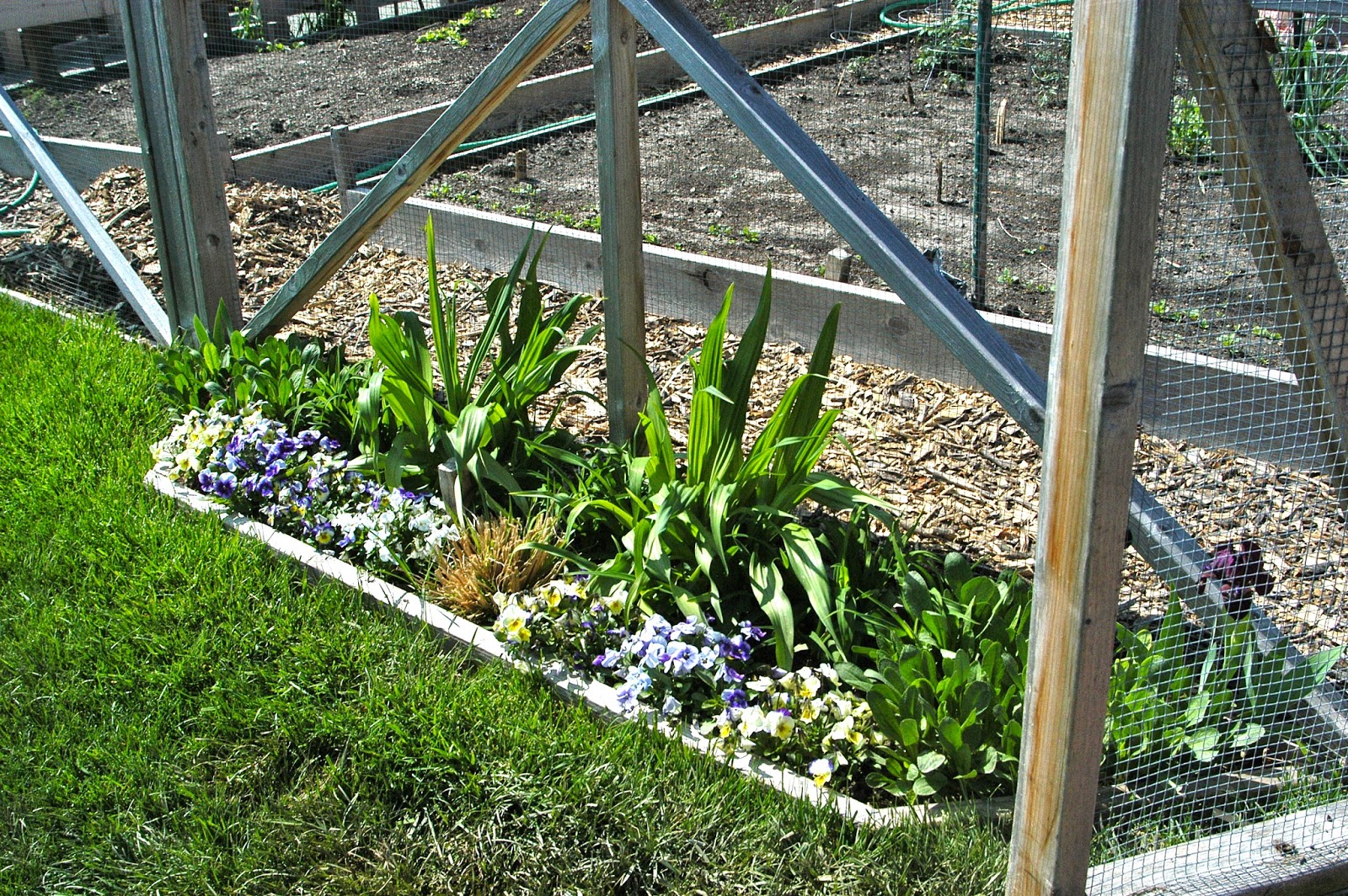
                          Attractive spring flowers on either side of the Crestwood Community Garden gate welcomed visitors to the dozens of organic vegetable plots warming [finally] in the welcome sunshine.
Norman was doing some heavy lifting while we were there. 

 Mushroom compost is often a favorite of local vegetable gardeners to add to their soil. 
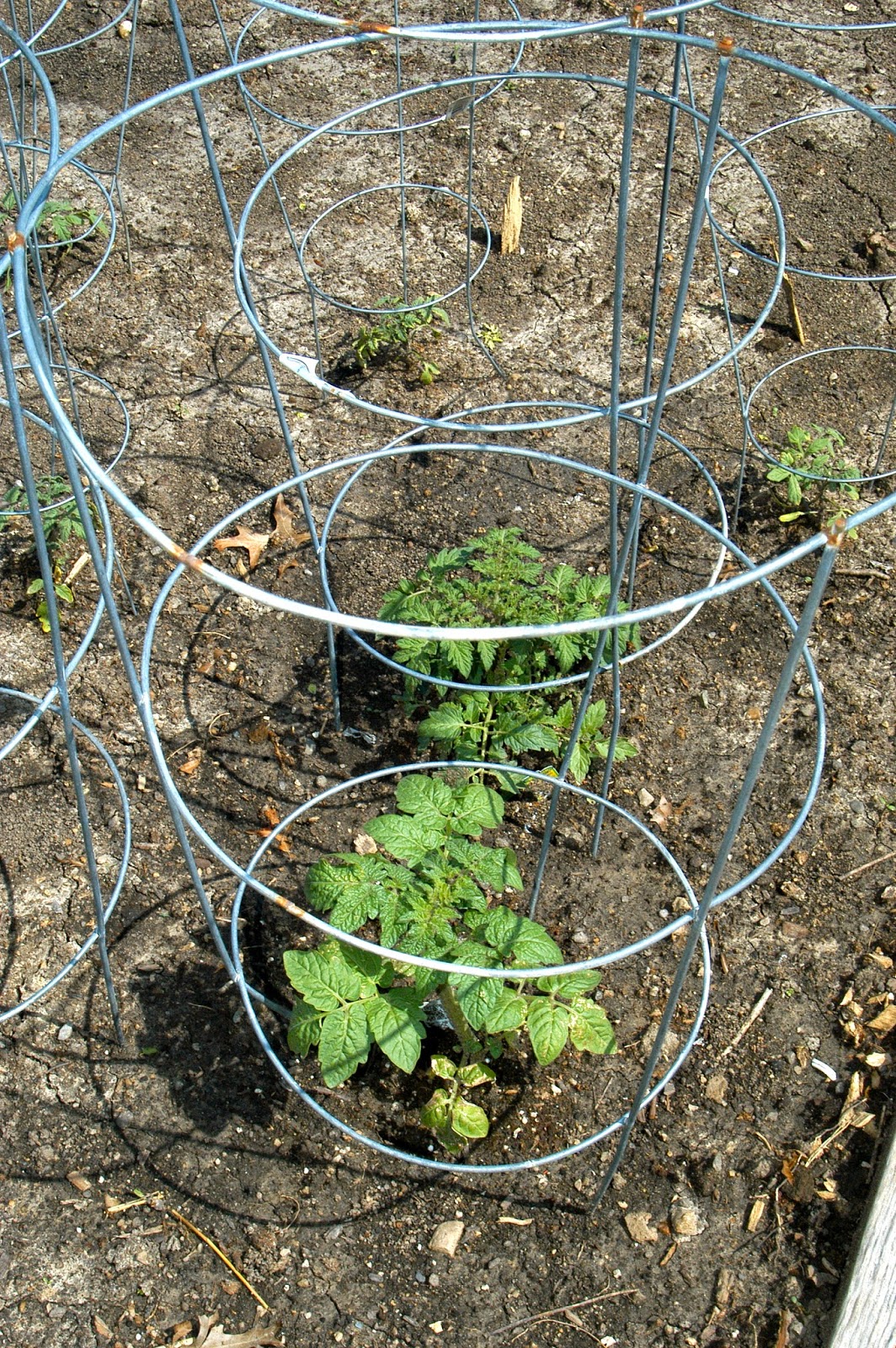
 These tomato plants got a good start already, so we thought we'd come 
back in a few weeks to see how they're doing.
Some of the tools and plants of the trade.

 Jean takes a rest on the comfortable garden seat provided by the 
community garden to provide some relief to local backs. 
Usha is new to gardening, but she has already learned a lot from the other gardeners. 
She has embraced organic gardening from using manure for fertilizer 
to the many packets of organic seeds she was about to plant.

 This little bench is indispensable. Everyone should have one. 
 This gardener clearly got a nice headstart, starting her planting several weeks ago, 
during our polar fleece spring.
 According to Usha, the man who works this plot made that trellis by hand. 
It should be covered in vines by June.
Here's Norman again, back with another load of chips. After several trips, 
he was starting to make a dent in the pile of wood chips at the bottom of the steps. We hear that flowers will be planted the length of the fence on the outside to attract pollinators like butterflies and honey bees. [Do not confuse the stripes of a fuzzy honey bee with the stripes of an unfuzzy yellow jacket. Yellow jackets are very aggressive and give bees a bad name. You'll find yellow jackets buzzing around food/garbage. They'll even raid a beehive for the honey. Honey bees like flower nectar. Just an FYI. Meanwhile, we look forward to watching this harvest grow and flourish. We'll be returning with more pictures to keep you apprised.  

INTERESTED IN RENTING YOUR OWN COMMUNITY GARDEN PLOT? 
Here's information we found on the Village of Northbrook website --
The group is a corporation formed separately from the Village, and is comprised of Northbrook residents.  The Northbrook Community Garden, Inc. has two gardens on village land; one located behind the Village Hall, 1225 Cedar Lane, and the other at Crestwood Place Senior Living Facility, 1000 Waukegan Road.  The group is a 501 (c) 3 and is designed to foster community togetherness, create an awareness and educate the community about the ecological benefits of locally grown food as well as the benefits of food grown without man-made chemicals.
If you are interested in joining the group, feel free to call Brian Bruce, co-founder, to learn more about renting a plot at 847/498-5008.

Thursday, May 8, 2014

Good News? We Can Only Hope.

We'll have to wait for the hype to die down to see if this is a real breakthrough or just Memorex. But if this idea goes, maybe you can tell your friends you heard it here first. [TRUMPET FLOURISH] 
Introducing environmentally-friendly 
bioplastic created from shrimp shells. Ta-da!
Read and watch the video HERE.


Wednesday, May 7, 2014

It's Imperative to Recycle CFLs, LED Lightbulbs, and Incandescents

Compact fluorescent lightbulbs and LED lightbulbs, for all their energy efficiency, qualify as hazardous waste by California standards when the end comes. Copper, zinc, gold, silver, mercury, phosphorus, barium, chromium, antimony, yttrium, and aluminum are examples of what can be recycled from CFLs and LEDs in the extraction process. 

So, while they are much more energy-saving during their lifetime, compared with incandescents, they have a far greater toxicity potential on the back end. Read the unpleasant details HERE.

That's why it's so important when they burn out -- don't trash 'em  -- recycle them. 

In Northbrook, your recycling options for CFLs, LED lightbulbs, AND incandescents are on the first Tuesday of every month at the garage behind the Village Hall. 


Tuesday, May 6, 2014

The Domino Effect Can Be A Good Thing

Evanston aldermen eye banning plastic bags after Chicago bill passes
Annabel Edwards/Daily Senior Staffer
Weinberg freshman Jessica Hoffman uses plastic bags after a trip to the drug store. Some Evanston aldermen say they would support a plastic bag ban in Evanston.
Patrick Svitek, Reporter
May 5, 2014 •
Some Evanston aldermen would like their colleagues to revisit outlawing plastic bags following the Chicago City Council's decision last week to partially ban them.
"I would certainly be willing to send it to a committee to at least have a discussion and review the Chicago ordinance," Ald. Ann Rainey (8th) said Monday afternoon, calling a ban a no-brainer given how many stores already require — or at least encourage — the use of reusable or paper bags. READ MORE. . .

Monday, May 5, 2014

A Pleasant Surprise! Sunset Foods Adds Reusable Bag Displays!

We stopped into Sunset today and discovered two new displays offering reusable bags. You can buy 6 for $5.00. A bargain! Sunset has offered reusable bags for a long time, but they've been languishing by the service desk, where they were hard to see. And easy to forget. 

NOT ANY MORE!!! YAY!

Now there's one display at their front door and one by the cash registers. We're hoping that this new initiative will help encourage shoppers to consider switching from paper and plastic to reusable. Can we count on you, too? [Send us a picture of your groceries in reusable bags and we'll post it!!]

Here are the Sunset reusable bag displays by the checkout aisles [above] and by the front door [below]. 

Thanks to Bruce and Ron for making this happen.           

Saturday, May 3, 2014

You are Invited to the IRA/SWANA Annual Conference June 3-4 2014

Go Green Northbrook has received an invitation to join the Illinois Recycling Association [IRA] and the Solid Waste Association of North America [SWANA] at their annual meeting in JUNE 2014. All GGN members are welcome to attend. NOTE: This event is not free. 

Please join IRA and SWANA for the “ReThink. ReDefine.” annual conference held June 3-4, 2014 at the Holiday Inn Tinley Park, IL Convention Center. You do not want to miss this exciting conference!

·         Keynote Speakers: Tim Carey, Pepsico Senior Director and Lynn Laszewski, Pepsico Resource Conservation Analyst

·          Gala Networking Dinner, Silent Auction and Entertainment:  A FUNdraiser and networking evening for connecting with business, government and academia! Enjoy cocktail hour, fine dining, magic show by Chicago magician Dennis Watkins and music by the talented “In The Green”! You could be the lucky winner of an iPad door prize – every attendee receives a free ticket! Raffle and silent auction items including VIP Experiences at the 2014 US Open and 2015 Final Four and Masters Tournaments!

·         15 Informative Breakout Sessions (session topics to include: Landfill Gas Control and Monitoring, Anaerobic Digestion, Electronics Recycling, Markets and Green Fence Recovery, Construction and Demolition recycling, Business Sustainability and Energy Efficiency, Waste Management Planning, Public Opinion, Reuse and more!)

·         Exhibit Hall on Tuesday and Wednesday
·         Awards Luncheon and Presentation
·         Recycling Tour: Willow Ranch Food-Scrap and Vintage Tech Electronics
·         Landfill Tour: Laraway and Prairie View
·         Table Topic Networking Groups at Wednesday Breakfast

Visit illinoisjointconference.com for conference details.

Friday, May 2, 2014

Chicago's Ban on Plastic Bags Doesn't Ban Plastic Bags

The headlines scream "Chicago Bans Plastic Bags", but is that really the whole story?


Probably the simplest way to understand Chicago's new, and potentially ineffective, ban on plastic bags is the way young "Activist Abby" [Abby Goldberg of Grayslake, IL] explained the effect of the aldermen's decision on her Facebook Page. [See below]


Abby was only twelve when her petition to Governor Quinn [with tens of thousands of signatures], got him to veto a bill endorsed by plastic bag manufacturers. This bill would have prevented local governments from passing ordinances to ban plastic bags in their towns. 


Here's what Abby posted about Chicago's recent ban on plastic bags, which, for some reason, will still allow "compostable" plastic bags: 


Green Plastic Bags = Biobags or compostable bags. Are they really green?

1] These bags do not degrade on the side of the road, in our waterways, or in your backyard compost pile. Our neighborhood farm [Abby's] that collects our compost refuses these bags because their compost pile does not get hot enough to degrade them. 

2] They do not degrade enough in a capped landfill.

3] The "green plastic" cannot be recycled! Sometimes people mistakenly put them in the recycling bin used to collect ordinary plastic bags and this contaminates the whole bunch. BLOG EDITOR'S NOTE: Some towns have ordinances that require ordinary plastic bags to be picked up by companies and returned to the few plastic bag manufacturers who are willing to chop them up and combine them with new plastic to make. . .wait for it. . .more plastic bags. And they call this recycling. 

4] They [the "green" bags] are still an eyesore as litter, a danger to animals, get caught in sewer grates, and act exactly like ordinary plastic bags. 

5] The term "Biobags" and "Compostable bags" is confusing to everyone. Most often biobags still have chemicals and plastic in them. EDITOR'S NOTE: Abby calls this "Green Washing" which Wikipedia describes as a "form of spin in which green PR or green marketing is used deceptively to promote the perception that an organization's products, aims or policies are environmentally friendly."

6] We use crops [corn usually] to make these bags, which require water, fertilizer, pesticides, and lots of energy for their growth. 

7] Green plastic bags are still something we use once and throw away!

Jordan Parker, Chicago's main proponent for really and truly banning the use of all plastic bags in favor of REUSABLES, wrote an excellent opinion in the Chicago Tribune that explains further what's wrong with Chicago's ordinance. [Her byline for the piece uses a different name].


She and Abby both agree, Chicago missed a huge opportunity because REUSABLE is the way to go. 

Wednesday, April 23, 2014

Busy Weekend! • Friday Movie • Saturday Go Green Northbrook Joins 50 Exhibitors Promoting Earth-Friendly Ideas!

FREE
•FRIDAY NIGHT• 
Go Green Northbrook presents
"QUEEN OF THE SUN"
Everyone is Welcome • Discussion Afterward   
• SATURDAY •
Earth & Arbor Day Celebration
Go Green Northbrook
Joins 50 Other Exhibitors
On the Village Green
9:30 AM to 1:00 PM
[Come at 8:30 AM to help with village clean up]


Saturday, April 19, 2014

Have You Thought About Raising Bees?


Bees are dying all over the word. Mites, viruses, parasites, bad weather, pesticides, lack of forage, and who knows what else, are conspiring to decimate the bee population. With bees in mind, maybe this is the year to learn more about organic lawn maintenance and skip the chemical sprays. 
          Meanwhile, interest in beekeeping is growing among green gardeners living in North Shore communities. On tax day, April 15th, some members of Go Green Northbrook went on a field trip to Highland Park's Heller Nature Center.  We joined several other folks from the northern suburbs who wanted to watch and learn about bees from naturalist, Leah Holloway, Heller's Head Beekeeper. Among Leah's many responsibilities, she is in charge of maintaining all the hives. 
          After a long, difficult winter, hives can die from the cold or run out of their supply of honey and starve. So even though it was chilly, the day was planned around preparing a batch of sugar water to feed the bees. The sugar water helps build up the bees' strength -- and provides a bridge between the end of winter and the blooming of flowers. This year it seems like winter won't end. And the flowers are taking forever to come up. 
          The sugar syrup recipe is fortified with lemongrass and other herbs to strengthen the bees' immune systems. A small amount of lemon juice per pound of sugar is added to help breakdown the sugar molecules to make it more like nectar, which is easier for bees to digest and put to use in the hive. Here are some links so you can learn more about feeding bees: Bee Hive Journal and The Bee Works.

Leah Holloway's friendly face greets the volunteers as they arrive at the Heller Nature Center. If you want to become a volunteer, call Heller @847-433-6901 to sign up. Before you volunteer, read some interesting FACTS about honey bees. Here's a TED talk about bees that discusses the slow, but relentless demise of bees over the last fifty years -- HERE. 

To start working around the bee hives, the volunteers have to climb into their bee suits. So we follow Leah outdoors to the new, critter-proof metallic container, where the bee supplies are kept.

          The Heller bees are very generous with their payback to the beekeepers. Every summer, honey from the hives is bottled and sold to the public. Proceeds from the sale of honey help support Heller's beekeeping and education programs.
                                                                    

It's been a long winter. There are just a few honey sticks left for sale. 
The feeder boxes stored on the left will hold the sugar syrup, which the bees access from inside the hive, through the bottom center of the feeder box. Opening the hive to put the feeder box in place takes effort with a pry tool, because the bees seal up any spaces with propolis or Bee Glue -- a resinous mixture the bees make from sap and other botanical sources. It's a natural disinfectant and antibiotic. According to Leah, Bee Glue works better than some commercial products.


      Volunteers eagerly start climbing into the bee suits. Not because they're flattering. As you might expect, anyone working around the hives is required to wear protective covering. Bees don't take kindly to human disturbances, no matter how well intended. Here's a LINK to an online store that prides itself on cheap bee suits, in case you want to get your own. Or need a good costume for Halloween.

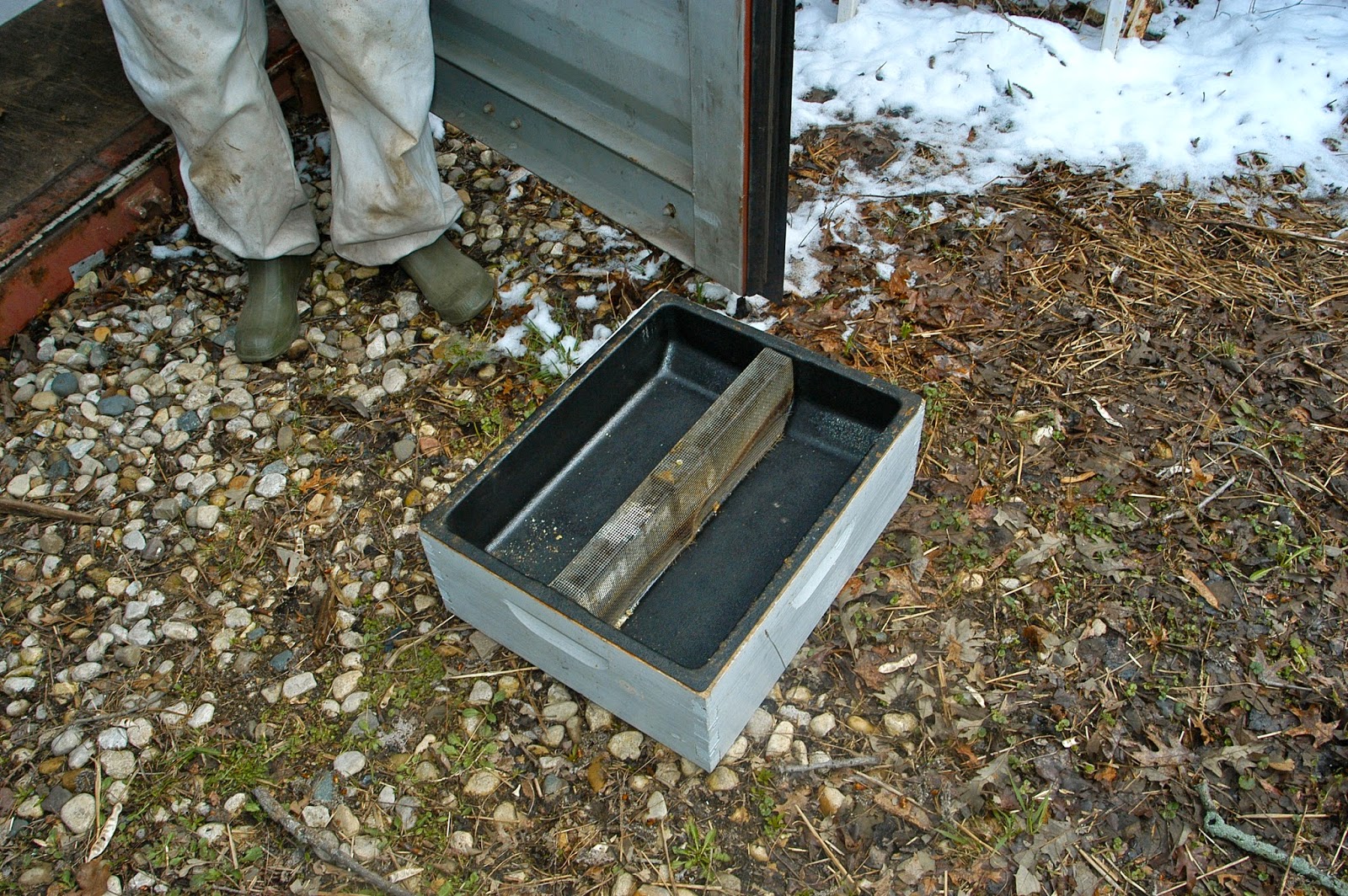
Below is a view of the inside of a feeder box. There are many kinds of feeder boxes. With just as many opinions about which ones are best. Here's a LINK to give you an idea. At Heller, the center of the box is screened to separate the bees from the sugar syrup -- to help protect them from falling into the liquid on either side and drowning. Unfortunately, this still happens from time to time.


After the bee suits come the gloves. The protective gloves fit high up on the arms, over the elbows. There are elastic bands on the bee suit sleeves that stretch over your thumbs to keep the sleeves from riding up when the gloves go on. Here's another LINK to an online store that carries a range of equipment and supplies you'll need. Just remember, no matter how much equipment you wear, you'll probably get stung anyway. It goes with the territory.


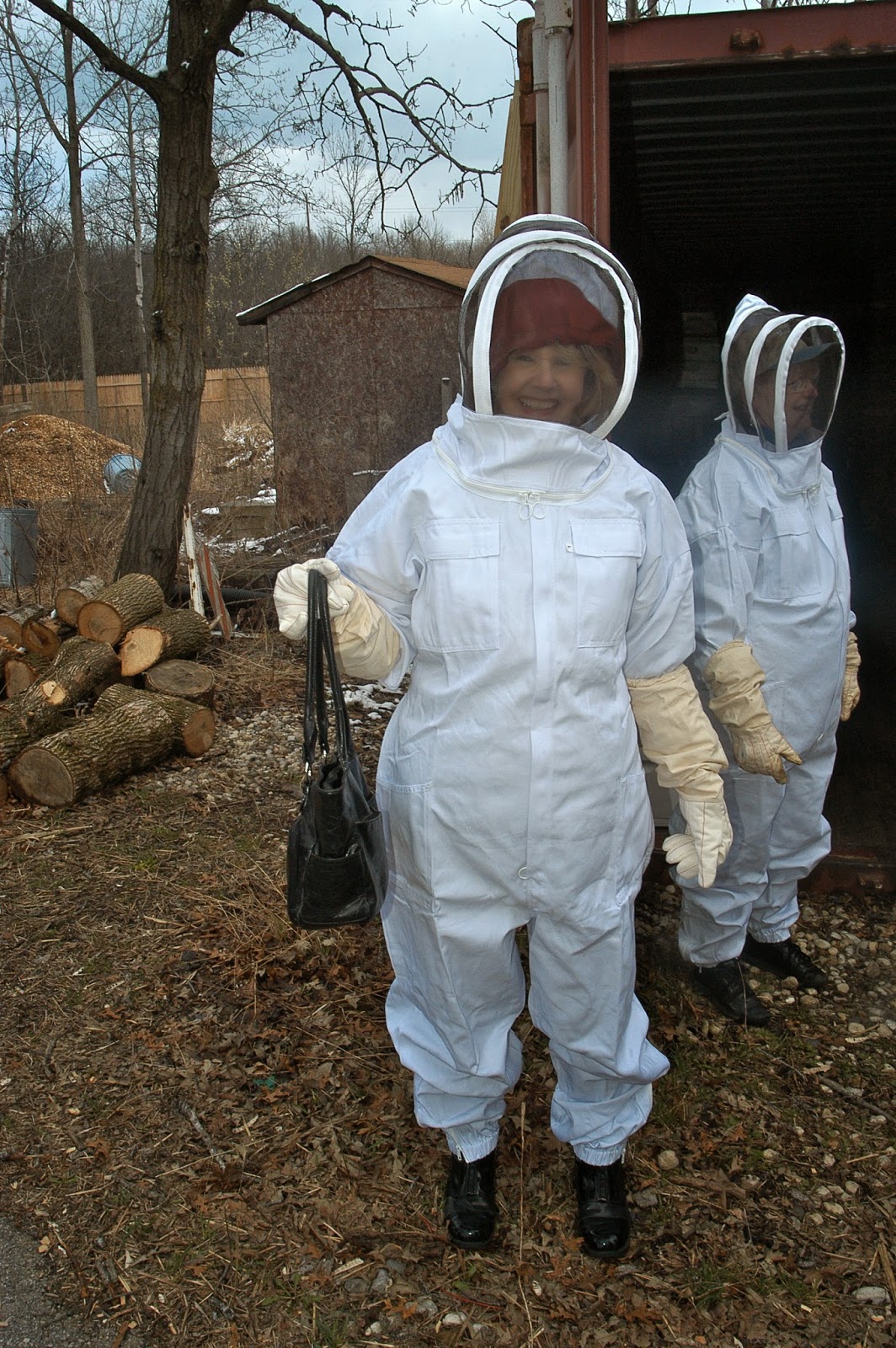
GGN's Barbara Gerleman models the latest in leather accessories for the fashionable beekeeper. We finally found a place to stash her handbag, so she wouldn't have any stray bees flying out of her purse on the way home. Next time she'll probably keep it in the trunk.

GGN's Merilee Novinson is sealed up nicely inside her bee suit. No tiny openings where a bee could crawl in. We noticed that the additional warm clothing needed on the cool, damp, spring day made the fit of everybody's bee suit kind of snug.

Time to carry the feeder boxes out to the hives. If you're curious about what's happening to kill off the bee colonies, here's another LINK that talks about the problem.

On the walk to the bee hives, we pass a cabin designed by famous landscape architect, Jens Jensen, originally used as a children's playhouse. It was donated to the Heller Nature Center by a local resident. 
      The feeder boxes will be placed at the top of the hive, underneath the cover. Here's a link for beginners that shows the parts of a beehive. Here are two descriptions about what bees go through to survive the winter 1) how the bees keep warm in the winter and 1) what is a winter cluster? 

As part of Heller Nature Center's mission to educate, Leah begins to prepare their traveling bee exhibit for display. It is built to allow a good view into the workings of a hive.

She will fill the yellow container with sugar syrup once the syrup has been made. Next, she'll move one of the surviving colonies into the traveling exhibit. Of the eighteen hives they had last year, three survived the winter, which is not bad, given the stress bees are under and the harshness of the past winter.


Leah takes apart the exhibit hive in preparation for all the bees that will follow their queen, who will be moved to her new home, once the sugar syrup has been added.

She slides clear panels into place so anyone who views the traveling hive can easily see what the bees are doing inside the hive.

After setting up the first hive, it's time to make the syrup. Water straight from the hot water heater is added to sugar, followed by the special mixture of herbals essences [Pro Health] and lemon juice. The beekeepers at Heller used to make everything from scratch. but the cost became prohibitive, so they switched to ready made products.

Leah holds the lemon juice which makes the sugar more digestible for bees. The sugar should only be white sugar. No brown sugar or molasses. In the recipes we read, we noticed there are different ratios of sugar to water, depending on whether the syrup is used in the fall or spring or to stimulate brood rearing.
          The water should be close to boiling temperature to dissolve the sugar. Some recipes suggest bringing the water to a boil, turning off the heat, then adding the sugar. After combining all the ingredients, it's time to stir and stir and stir.                         

Lemongrass oil, spearmint oil, and lecithin are just a few of the ingredients in the Pro Health supplement added to the sugar syrup. There's also a mild laxative. During the winter the bees will leave the hive to evacuate their digestive systems, if it gets warm enough. However, following our recent cold winter, they may not have been able to leave very often, if at all. Enough said.  

The sugar syrup is poured into the container in the exhibit hive before the queen bee is moved into it.


The top of the hive is removed and the search for the queen begins. Once she has been found and moved to the exhibit hive, the rest of the colony will follow her distinctive pheromone. You may be able to see the bees piled in their winter cluster, bunched together for warmth inside the hive. After using a bee tool to open up the hive, Leah and the volunteers start moving the honeycombs and other infrastructure.


Needless to say, stirring up the hive with the bee tool is a process that annoys the heck out of the bees. But that's what the bee suits are for. If you're interested in trying your hand at beekeeping, we recommend signing up to be a volunteer at Heller Nature Center. You can also find starter kits HERE. And get your very own copy of Beekeeping for Dummies HERE.


You'll probably also want some remedies for bee stings, so here's a link from WEBmd.  If, instead of beekeeping, you want to plant flowers that attract bees, check them out HERE. Finally, you could start a Go Green Northbrook Beekeeper Team. And raise bees with other Northbrook residents. Just a thought. 

          We'll leave you with some pictures of flowers now blooming in Merilee Novinson's legendary yard. And a gentle reminder to plant some flowers that attract bees, plus a request to stop using pesticides and herbicides.